When To Stop Self-Treating And See Someone
The commonest mistake with feet is not doing the wrong thing. It is doing a reasonable thing for far too long before asking anyone.
Feet are private. People will discuss almost any other symptom at the dinner table and say nothing at all about a toe they have been worrying over for two years. That reluctance is the reason small, easily handled problems routinely turn into long ones.
Here is a plain threshold. Any one of the following is worth an appointment.
1. It is painful
Not uncomfortable in the wrong shoes. Painful, in a way that changes how you walk or what you are willing to do. Pain that alters your gait tends to create a second problem further up in the knee, hip or back, so it rarely stays a foot problem for long.
2. It is spreading
Something affecting one toe that now affects two, or one foot that now affects both, has told you something useful: whatever is driving it is still active. Whatever you are doing is not reaching it.
3. It has not changed in a month
Give a reasonable approach a fair run, then judge it honestly. A month with no change at all is a month's information, and it is telling you to try something else rather than the same thing for another six.
4. The skin is broken
A crack, a split, an area that weeps or will not close. Intact skin is a barrier. Broken skin is a door, and on a foot that spends the day inside a warm shoe it is worth closing quickly.
5. You have diabetes, poor circulation or a weakened immune system
This one overrides the rest. If any of these apply, the threshold is not a month, and it is not whether it hurts. Anything new on the foot is worth showing to someone, and quickly. Reduced sensation means the usual warning system is not reporting accurately, so you cannot rely on how it feels.
What to expect
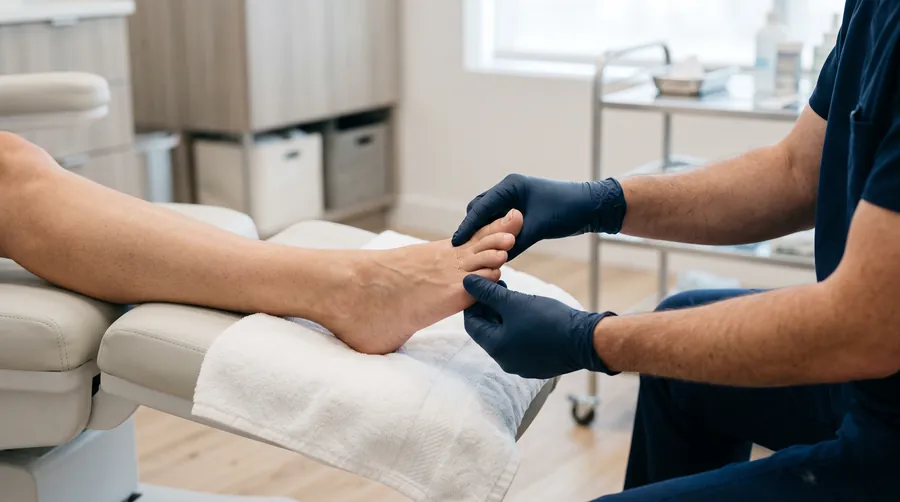
Podiatry appointments are shorter and less dramatic than people brace for. Someone looks at the foot, asks what you do all day and what you wear on your feet, and tells you what they think it is.
Take the shoes you actually wear most with you, not your best pair. It genuinely helps, and it is the question people most often cannot answer usefully from memory.
Nobody who does this for a living will be remotely surprised by your feet. It is worth remembering that the embarrassment is entirely on your side of the desk.